Language skills your students can prove.
The Global Seal certifies your students' language proficiency with a credential that is verifiable, comparable, and easy to share. Use it to attract multilingual students, place them in the right course, and keep them enrolled through the next one.

Language skills your students can prove.
20%
or more of certificates awarded by colleges and universities
70+
countries where certificates are issued
170+
languages we certify

The language micro-credential
The Global Seal isn't just borrowing the language of micro-credentials — it's implementing the specific design features (early award, portability, recognition of outside learning, low institutional cost) that the higher-ed research identifies as the actual drivers of enrollment, retention, and completion gains.
Per the Micro-Credentials Impact Report 2024, 51% of higher-education institutions reported that they already offer or integrate micro-credentials. Among institutions that had not yet adopted them, 68% planned to do so within five years. Micro-credentials are reshaping how institutions recruit, retain, and recognize student achievement, and language proficiency is no exception. The Global Seal of Biliteracy gives bilingual and multilingual students a portable, stackable credential that documents their proficiency the moment they earn it, not just at graduation.
Free to implement and easy to incorporate into existing coursework, the Global Seal recognizes languages beyond what's taught in-house, supports students pursuing minors or double majors, and produces a shareable, transcript-ready certificate that strengthens job and university applications. For institutions looking to boost enrollment, deepen retention, and give students a credential that counts, the Global Seal offers a proven, low-friction way to make multilingualism visible, and valuable.
Three Levels of Certification
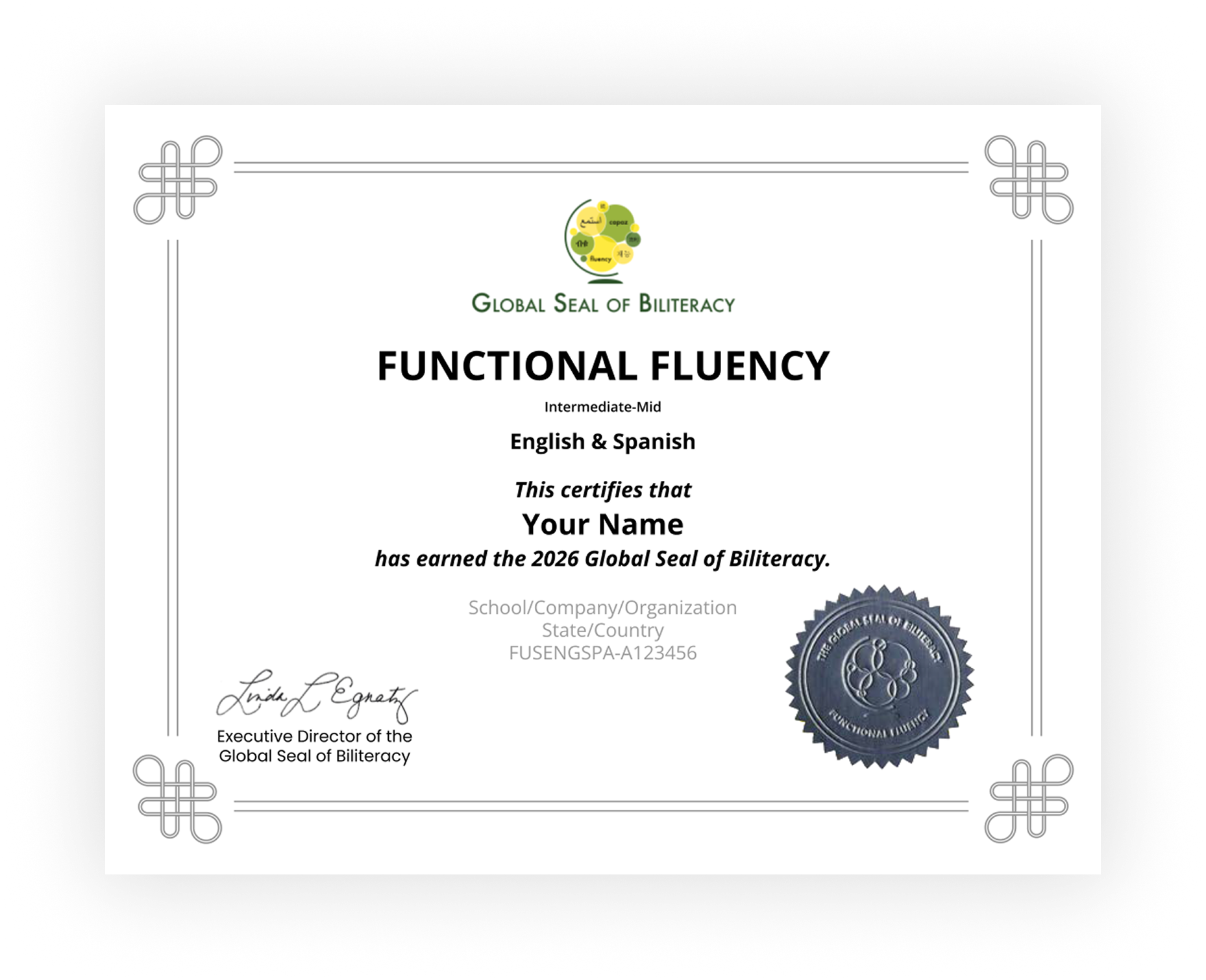
Functional Fluency
This individual can navigate daily routines and predictable situations in their certified languages. They can describe services, follow procedures, and respond to frequently asked questions, though some grammar errors or mispronunciations may occur.
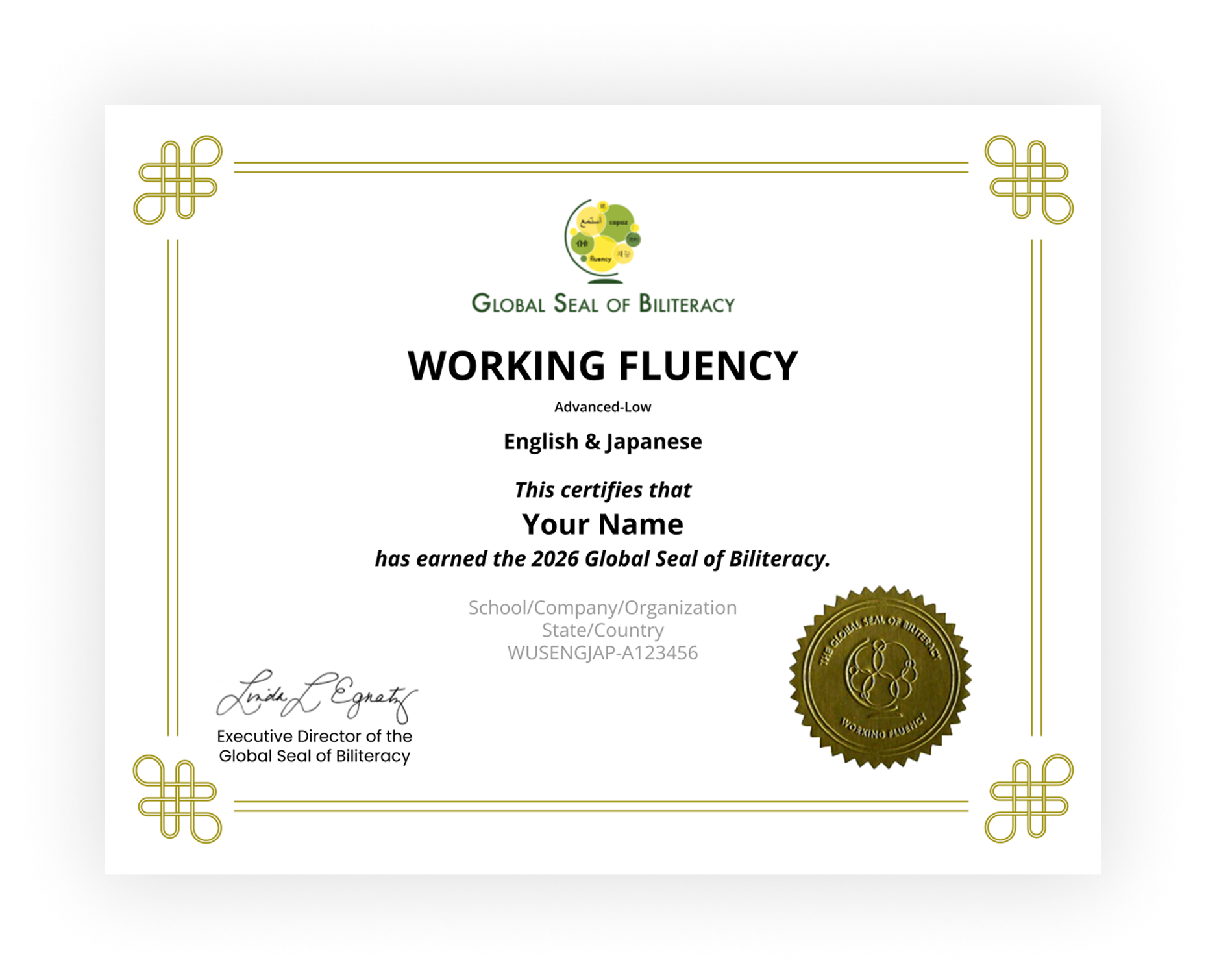
Working Fluency
At this level, the certified individual can handle both routine and unfamiliar situations across formal and informal contexts. They can adjust their language, make recommendations, explain policies in detail, and resolve problems with overall accuracy and understanding.
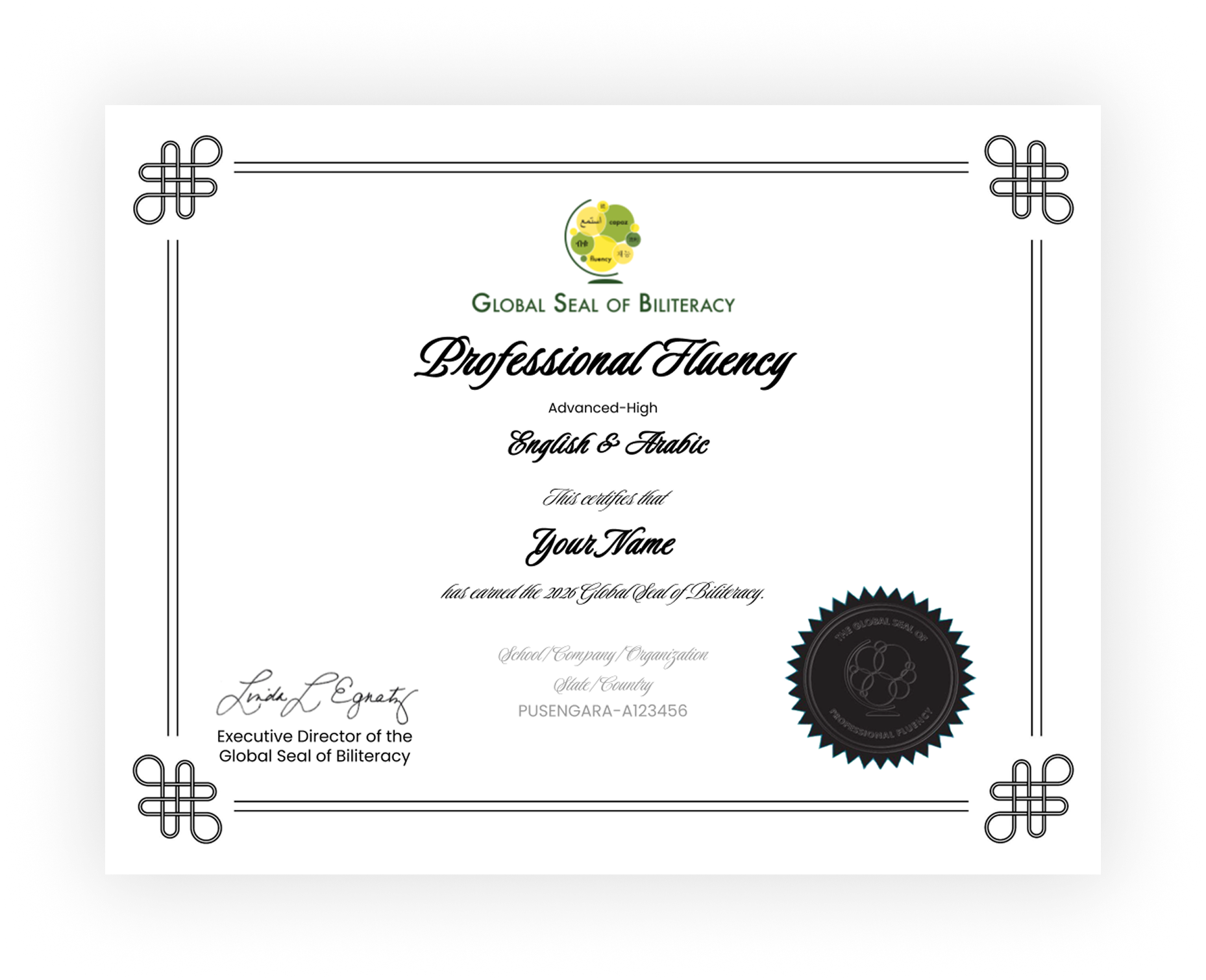
Professional Fluency
The highest certification validates advanced mastery. These individuals interact with precision on a wide range of complex topics. They excel at persuasion, negotiation, delivering presentations, and participating in the linguistic and cultural nuances of professional environments.
Program Benefits
Build enrollment. Attract proven language learners and create faster paths to minors, majors, and advanced coursework.
Simplify placement and credit. Use a documented proficiency credential to place students accurately and reduce repeat testing.
Expand your reach. Award competency-based credit to majors, non-majors, double majors, and degree-seeking adults alike.
Launch at no cost. Add a globally recognized language credential without a new institutional budget line.
Join a proven model. Colleges, universities, and employers already issue more than one out of five of all Global Seal certificates.
“We are seeing meaningful impact across a wide range of student pathways and academic disciplines. Students earning the Seal represent diverse majors, including dual-language education, engineering, international business, single-subject mathematics teaching, and many others, demonstrating that multilingualism supports success across fields, not only in education. Graduates have used the Global Seal as a professional credential in employment and graduate opportunities, while also experiencing cultural affirmation through formal recognition of their linguistic identities.”
Student Benefits
More languages recognized. Certification in 170+ languages, including heritage, less commonly taught, and self-taught languages.
A credential that travels. Internationally recognized, and it follows students across institutions, states, and careers.
Language skills become career capital. Students can show verified proficiency to employers on a résumé, a CV, or LinkedIn.
Students stay in control. A Digital Language Profile lets them store, verify, and share their credentials wherever they choose.
Progress is rewarded at every level. Three certification levels give students a way to level up rather than wait until the end of a sequence.
“Finally, a test that means something.”

Higher Ed Enrollment Pathways
For language departments under pressure to grow upper-division enrollment, the Global Seal of Biliteracy functions as more than a credential, it's a ready-made placement and recruitment engine. Because the Seal is awarded through internationally recognized and validated proficiency assessments, departments can use it as a free, standardized placement tool: students arrive with their proficiency level already documented, eliminating the guesswork and administrative burden of in-house placement testing.
Programs at institutions like the University of Idaho and University of Texas Arlington have built on this by turning accurate placement into an enrollment pipeline, awarding up to 16 and 14 college credit hours, respectively, the moment a Global Seal holder enrolls in the next-level course in their language. That structure does double duty: it removes the redundancy that discourages proficient students from enrolling at all, while funneling them directly into upper-division seats departments most need to fill.
The concern that such credit might cannibalize enrollment isn't borne out in the research. Fares, Forbes, and Reeder's study on AP Spanish credit found that granting credit for demonstrated proficiency didn't shrink upper-level enrollment. Rather, it grew as students who might otherwise have skipped redundant coursework instead stayed in the program and advanced further. Applied to the Global Seal, the same logic holds: competency-based placement paired with retroactive credit doesn't just make the on-ramp easier for incoming students—it's a strategic tool for building enrollment where universities need it most.
“Upper-division course enrollment has almost doubled since adopting the Global Seal of Biliteracy, and we have added majors and minors too”

Turn scholarship dollars into a recruitment funnel
Rather than awarding scholarships to already-enrolled majors, programs can use the Global Seal to identify and attract prospective students before they enroll. The Seal lets institutions identify and attract students with proven language skills. That means admissions and language departments can proactively court high school Global Seal holders with scholarship offers tied to continued language study, rather than waiting to discover language talent after the fact.

Placement-ready data straight to your registrar
Every Global Seal is earned through a rigorous, internationally recognized exam that tests all four skills — listening, reading, speaking, and writing. Composite scores don't qualify. Every exam is vetted by our International Board of Advisors against strict test selection standards, so the credential means the same thing no matter where or how it was earned — across more than 170 languages and 70+ countries.
That rigor is what makes the Seal a placement tool your university doesn't have to build or fund. Instead of running your own placement exams — a cost and logistics burden that scales with every language you offer — you can rely on a credential that's already done the work, with a level of accuracy in-house testing rarely matches.
Each Seal can be transcripted directly from the Global Seal to your institution, securely and verifiably, with suggested ACE competency-based credit attached to the student's proven proficiency level — turning a third-party credential into a document your registrar can act on immediately, with no manual verification step in between.
The payoff shows up where it matters most: accurate placement means fewer students defaulting into intro-level seats they've outgrown, and more of them landing directly in upper-division courses to grow majors and minors.That same placement accuracy extends to international students and students returning from study abroad, populations that are often hardest to place correctly with domestic-only assessment tools.
Program retention
Stackable credentials don't just recognize skills, they keep students moving.
82% of institutions report increased student engagement tied to credentialing, and 75% of higher ed leaders link microcredentials to stronger retention. Nationally, 40% of certificate-earners go on to stack additional credentials, evidence that one credential doesn't end a student's momentum, it builds it.
The Global Seal works the same way. Many programs test students at the end of a lower-level course, awarding a credential that complements their major and gives them a verified, shareable record of their skills. That record becomes the reason to keep going: students advance toward the next certification level instead of stopping where they started.
The result: more motivated students, stronger matriculation, and a retention strategy that pays for itself in the credit hours it protects.
“Our students are proficiency tested at the start of the major program and again on completion of the major. Many of our students entering the major earn a Functional Fluency Seal, and this has motivated them to set their sights on achieving the Working Fluency Seal.””
Employers are looking for this evidence. In a Job Outlook Survey by the National Association of Colleges and Employers, 60% of employers said they want to see proof of skills on a recent graduate's résumé.
Interdisciplinary Connections
Pairing language study and certification with other disciplines fosters the development of holistic skills that are essential for success in the modern workforce. By providing students from various disciplines an opportunity to document their language skills, universities create opportunities that ensure that students not only develop specialized knowledge in their fields but also cultivate strong communication and language skills, enhancing their overall competence and employability. Whether it's business, healthcare, engineering, or any other field, students benefit by having tangible evidence of their language proficiency, enhancing their credibility and readiness for the workforce. When coupled with language specific courses tailored to the specific contexts and communication requirements of their chosen profession, students are empowered to succeed.

The Process
A Simple 3-Step Pathway to Certification
Issuing a Global Seal of Biliteracy is straightforward through the program's quick and easy application, and award process. Providing this international certification to your students is as simple as sign-up, submit, receive. There is no cost to your university/college or your students. You pay only for testing, and you pay the testing company directly.
Sign-Up
An official representative of the institution signs-up and creates an Organization account on the Global Seal's secure platform. The sign-up process collects contact information and a few details about your program. Once your account is set up, you'll have access to dashboards where you can track certificates issued and measure your program's impact over time.
Submit
To validate proficiency, you'll need to prove skills in two languages for all candidates (staff and students). This includes uploading test scores from one of our approved language assessments taken within the last 12 months. All applications for the first certification in the U.S. must include English for either the first or second certification language.
Receive
Once scores are reviewed and approved, each qualifying student or staff member receives an official Global Seal certification. It records their first language, their tested language, and their fluency level.
Global Seal Colleges and Universities
Akademia Ignatianum w Krakowie
Alma College
Auburn University
Bates College
Benedictine College
Berry College
Birmingham-Southern College
Bob Jones University
Boise State University
British International University Erbil
Butler University
California Polytechnic State University, San Luis Obispo
California State University, Long Beach
California State University, Monterey Bay
California State University, San Bernardino
Carleton College
Clemson University
Coastal Carolina University
Coker University
College of DuPage
Concordia College
Davis and Elkins College
Delaware State University
Denison University
Dickinson College
Drew University
Emory & Henry College
George Fox University
Gillette College
Gordon College
Green River College
Greenfield Community College
Harding University
Hartwick College
Holyoke Community College
Indiana University
Indiana University of PA
Indiana University South Bend
Institución Universitaria Colombo Americana
Kalamazoo College
Kansas State University
Marquette University
Metropolitan State University Denver
Middle Tennessee State University
Middlebury Language Schools
Monmouth University
Montana State University
National Cheng Kung University
Northern Kentucky University
Northwestern University
Ohio Wesleyan University
Oregon State University
Pacific University
Pittsburg State University
Ramapo College of New Jersey
Randolph Macon College
Rhodes College
Saginaw Valley State University
Saint Mary's College
San Diego Mesa College
San Diego State University
San Francisco Pacific Academy
Skidmore College
Southeast Missouri State University
Tulane University
University of Alabama at Birmingham
University of North Carolina Wilmington
University of Dayton
University of Delaware
University of Hawai'i- Mānoa
University of Idaho
University of Illinois Chicago
University of Iowa
University of Mary Washington
University of Missouri, St. Louis
University of Nebraska at Kearney
University of Nevada at Reno
University of Oregon
University of Pittsburgh at Greensburg
University of Portland
University of Richmond
University of Southern California
University of Texas at Arlington
University of Texas at Austin
University of Toledo
University of Washington
University of Wisconsin
Virginia Military Institute
Walters State Community College
Washington & Jefferson College
Washington State University
West Virginia Wesleyan College
Western Kentucky University
Western Oregon University
Wheaton College
Wittenberg University
Wright State University
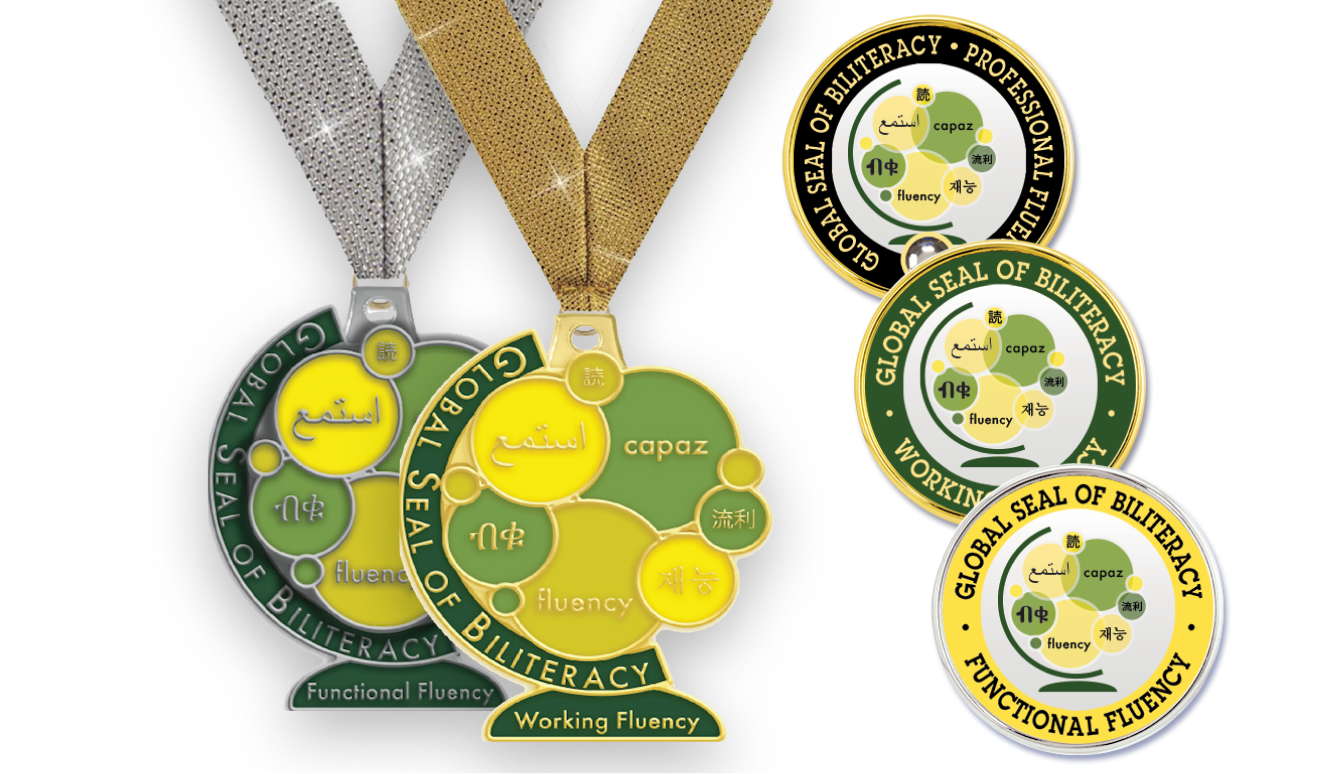
Recognition for graduation and honors
Certification is digital. For graduation and awards ceremonies, your institution can order recognition items including printed certificates, medals or pins, and honor cords.
Frequently Asked Questions
-
language proficiency, regardless of the approved test taken by the recipient. This certification is an industry-recognized proof of language proficiency for both academic and professional purposes, making it a valuable asset for students and graduates in an increasingly globalized world. The Global Seal's rigorous standards, test approval process, and partnerships with reputable testing organizations ensure its reliability and credibility.
-
The Global Seal of Biliteracy is a cost-effective program that certifies an individual's biliteracy based on language testing. Thanks to the support of our sponsors and donors, there are no direct costs for institutions or students to participate in the Global Seal program. However, the language tests themselves are administered by independent testing companies, and the expenses for these tests are paid directly to the respective companies by educational institutions, organizations, businesses, or individuals.
-
Integrating the Global Seal into your institution's language curriculum and assessment processes is straightforward. If your institution already uses one of our approved tests, you can easily submit existing test scores to the Global Seal for certification. If you are not currently testing, we recommend administering tests at the beginning and end of a term or academic year to track your students' progress towards proficiency. Some programs use an approved test as an end-of-sequence exam for courses with Intermediate-Mid targets as a way to document the language skills of students exiting the program and excite them about leveling-up while adding a major or minor. The test data can be valuable for assessing program effectiveness and demonstrating the value of your language programs to stakeholders.
-
The Global Seal offers certification in over 100 languages through its network of approved tests. This extensive language coverage enables higher education institutions to support and recognize the diverse language skills of their student body. Visit our Languages page for a comprehensive list of the languages we offer.
-
The technical requirements for administering the Global Seal tests are determined by the individual testing companies. Many tests are delivered online, providing flexibility for institutions and students. To ensure the integrity of the certification, all tests submitted to the Global Seal must be proctored by an impartial individual.
-
The Global Seal is committed to supporting higher education institutions in monitoring student progress and evaluating program effectiveness. While we currently do not provide organization-specific metrics, we are actively working on developing reporting tools that will offer valuable insights into student performance and program outcomes. These reports will help institutions make data-driven decisions to enhance their language programs and demonstrate their value to key stakeholders.