
Identify, celebrate, and empower your multilingual students.
Every school has individuals whose language skills go unseen and uncelebrated, spoken at home, learned from a grandparent, acquired independently online, or taught in a classroom down the hall. The Global Seal provides a free way for your school to award them an internationally recognized, shareable credential that opens doors to college credit, advanced placement, scholarships, and a resume line that says their bilingualism is an asset, not an afterthought. It works for every multilingual student or staff member in your building, including the ones who know or are learning languages you don't teach.

Recognize the languages your students already speak.
170+
languages we certify
70+
countries where certificates are issued
16
college credits a student can earn at some universities

Empowering multilinguals worldwide
Students today need to communicate across cultures. The Global Seal validates that ability with a certificate universities and employers recognize.
It is free, it is inclusive, and it is digital. Students can show their language skills to colleges, employers, and anyone else who asks, from middle school onward. There are no age or grade requirements, individuals can be awarded their certificate as soon as they qualify and as their skills grow, they can earn additional higher proficiency level credentials.
Shareable micro-credentials make learning visible, celebrate achievement, and motivate students to keep going. Research shows that a Seal of Biliteracy program increases language course enrollment and retention. See the research →
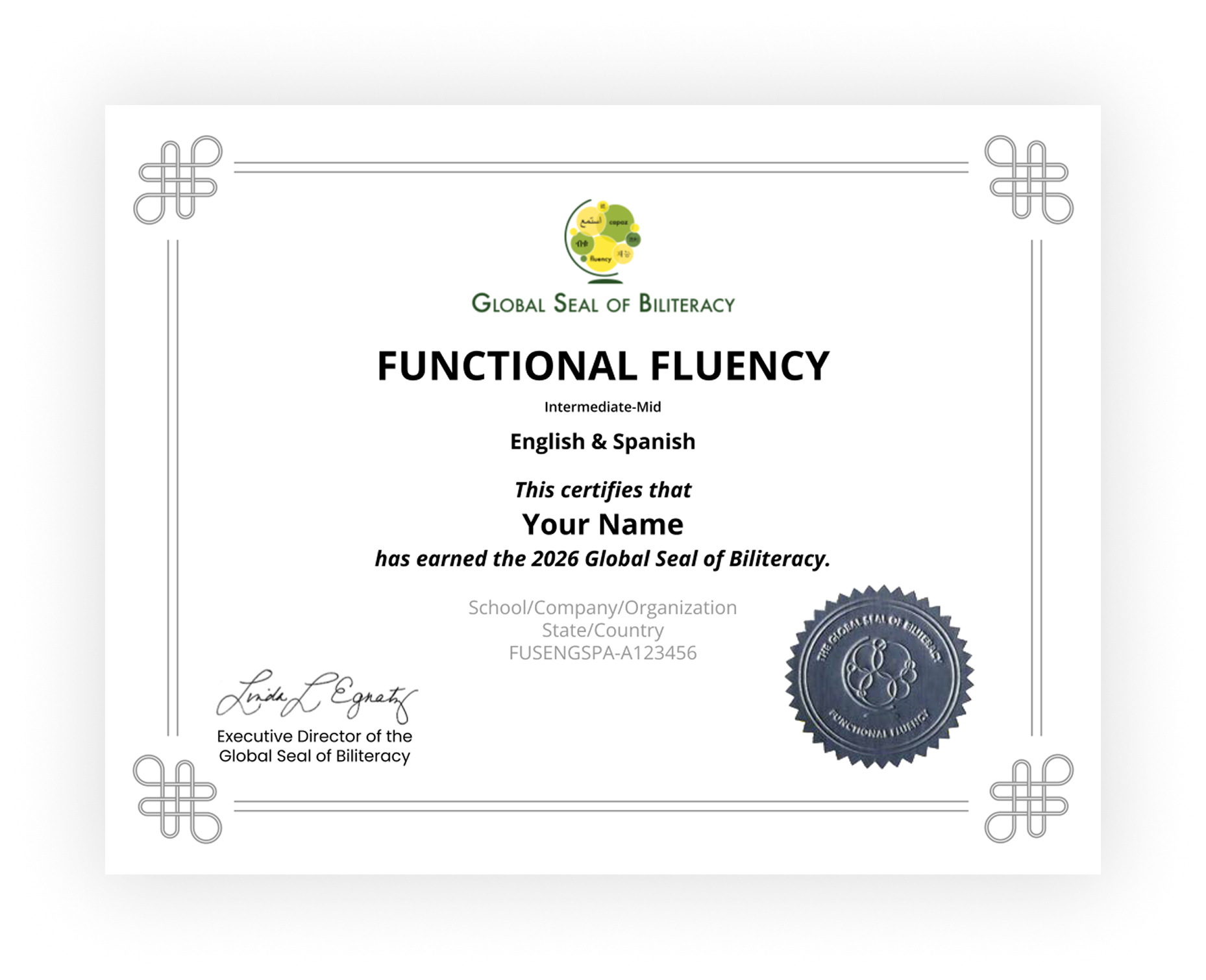
Functional Fluency
Handles daily routines and familiar situations. Can describe services, follow steps, and answer common questions. Some grammar and pronunciation mistakes are expected at this level.
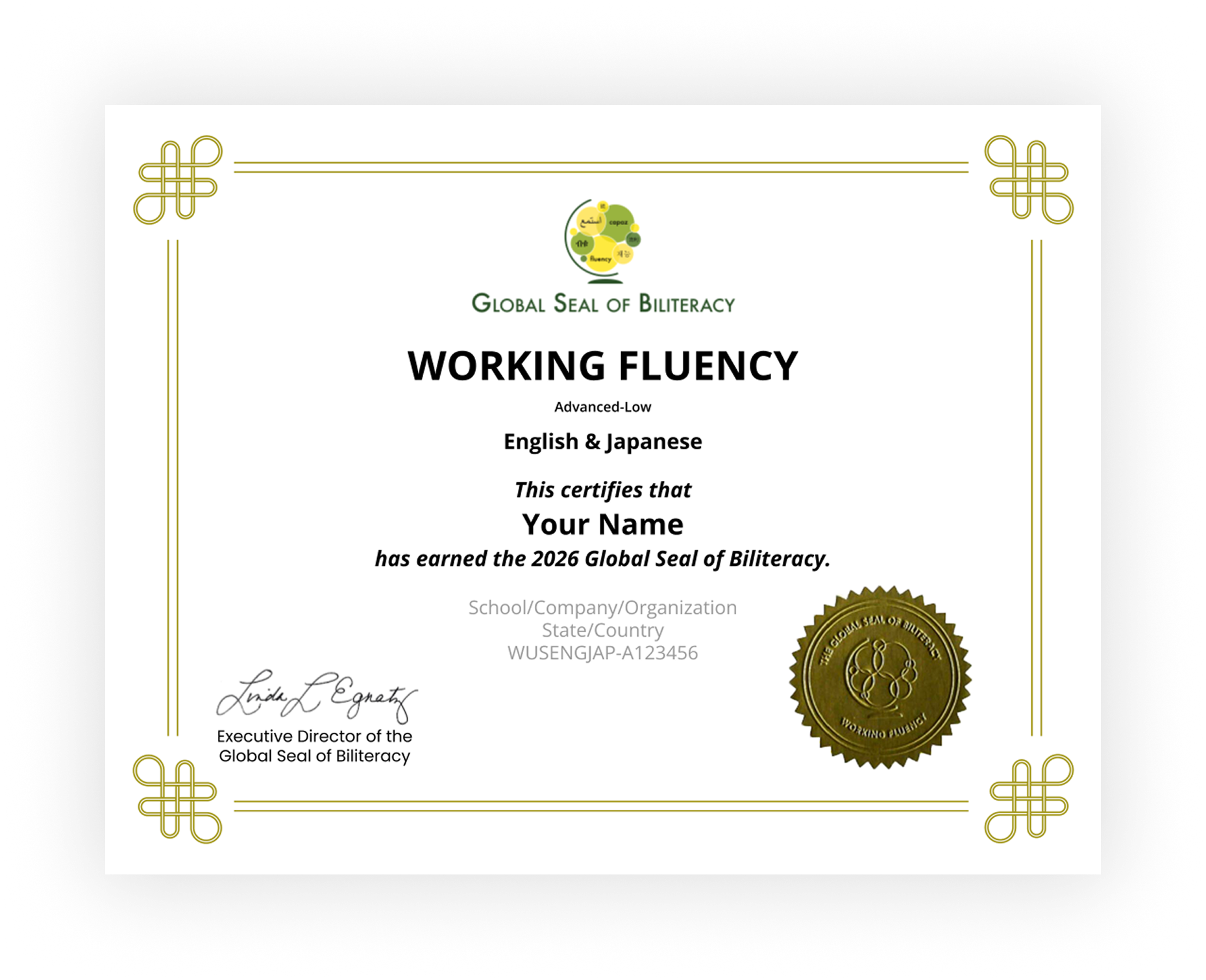
Working Fluency
Handles both familiar and new situations, in formal and informal settings. Can make recommendations, explain things in detail, and solve problems accurately.
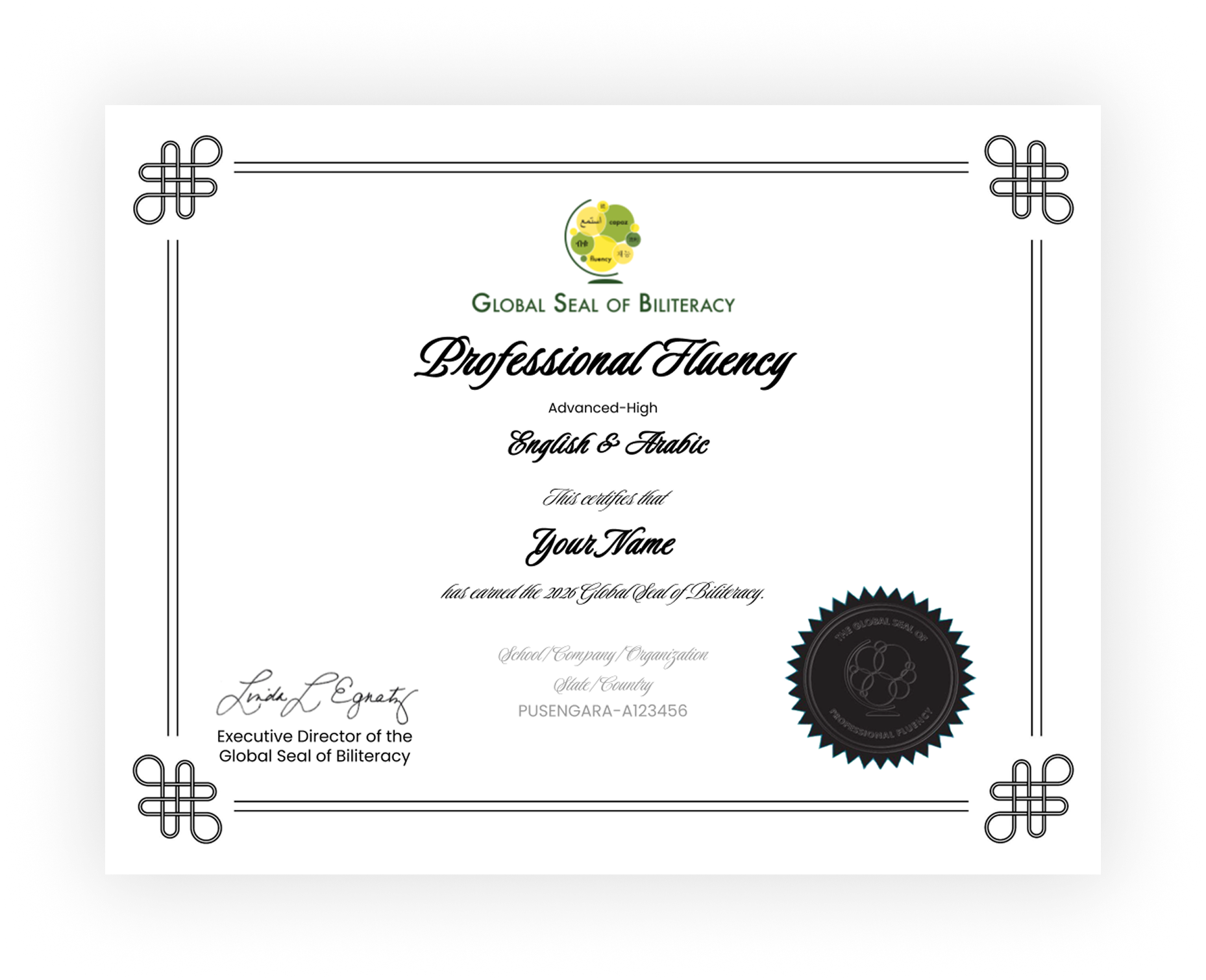
Professional Fluency
The highest level. Communicates clearly on complex topics. Can persuade, negotiate, present, and work within the cultural expectations of professional settings.
What students gain
The Global Seal helps students recognize their hard-earned language skills, verify them with a trusted credential, share them digitally, and use them to open doors.
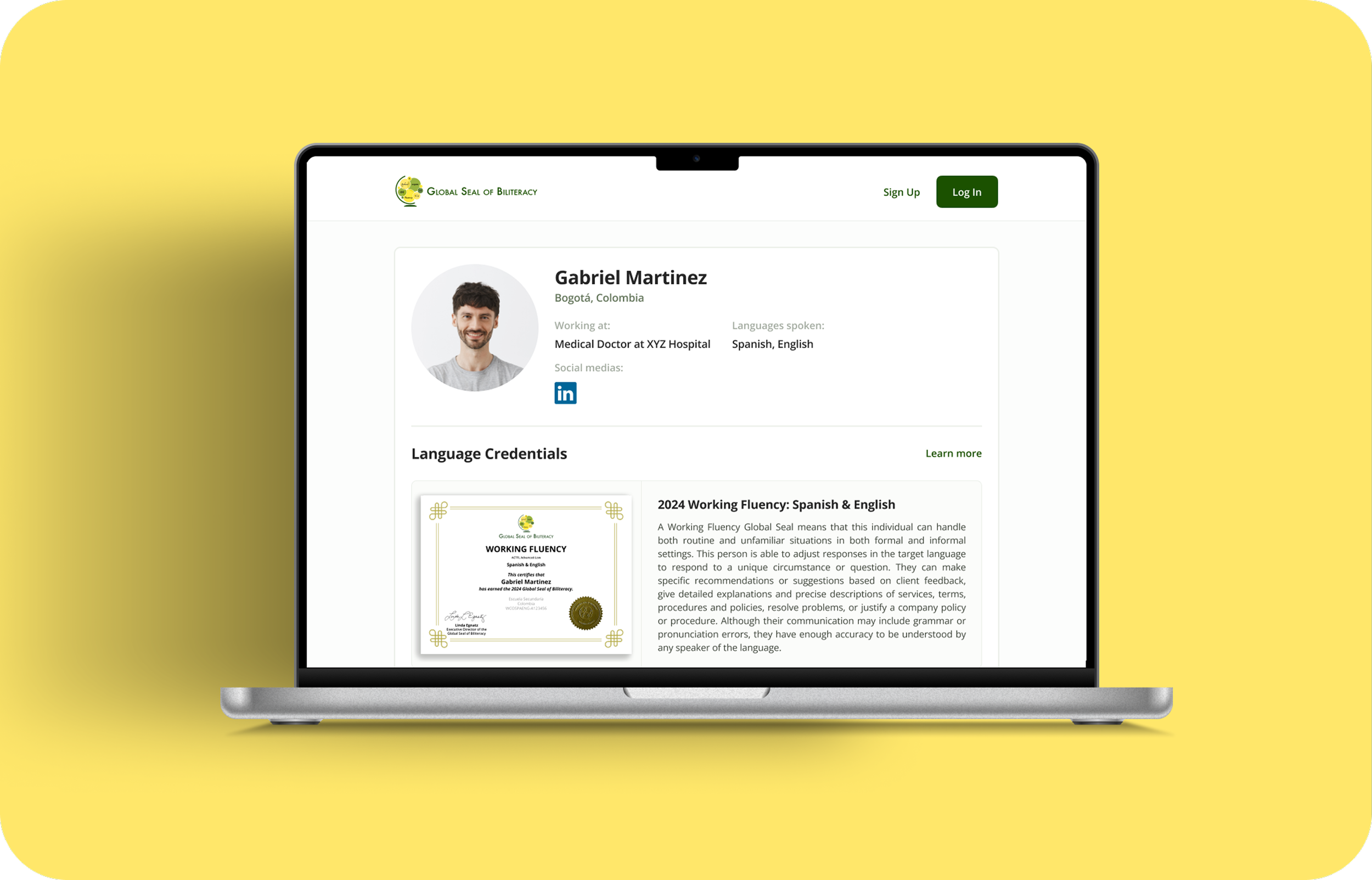
It counts on university applications. The Global Seal counts as an International Honor on the Common App and students can use their Digital Language Profile to send an official language transcript directly to a university.
Students earn it as soon as they qualify. Don’t wait for graduation to recognize your students. Award the Global Seal as soon as they qualify so the credential is ready for job and university applications.
It recognizes languages you do not teach. Heritage speakers, immersion students, and self-taught learners can all certify.
It may earn college credit or advanced placement. Some universities award up to 16 college credits or advanced placement to Global Seal holders. The credential officially documents a student's current language proficiency, giving universities the verified proof they need to award credit and place students accurately — no additional testing required. See college credit →
It is shareable and verifiable. Each certification lives in a secure Digital Language Profile students can link to on an application, résumé or LinkedIn, or send as an official transcript.
““Having this seal allows employers to see not only that you have functional fluency but also the dedication to learning a language. Thanks to my Global Seal, I was able to get a job at a physical therapy clinic straight out of high school.””

What your program gains
Course enrollment and retention go up. A single certificate isn't the end of the road, it's the next level to unlock. Students who earn a credential have a clear reason to stay enrolled and advance, and the path there is built like a game: Pathway ribbons mark progress at pre-certification levels, giving students recognition for growth long before they reach a full certificate. From there, they climb toward one of three certification tiers, each one a milestone worth staying in the course for.
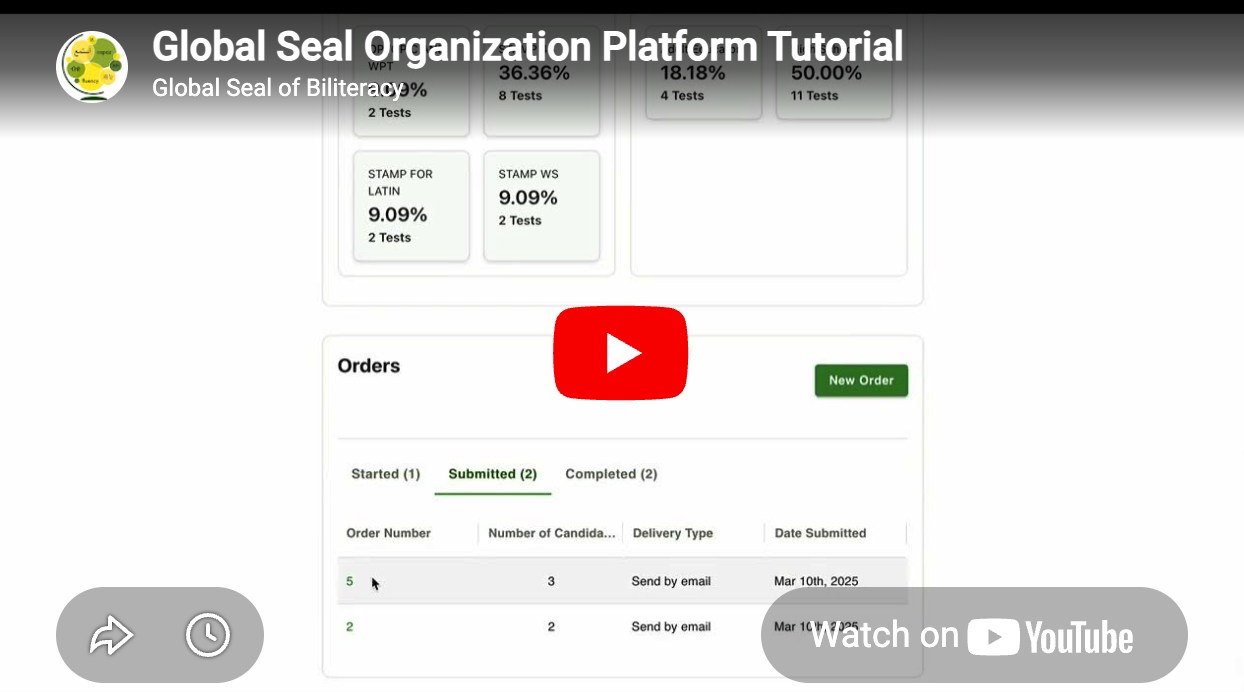
You get proficiency data. In addition to your testing data, organizations that award the Global Seal have access to all of their certification records and proficiency growth data through dashboards on the Global Seal's secure platform. Generate reports to share with administrators and school boards on the effectiveness of your program.
Every multilingual student is included. Your credential reaches students across the building, not just those in your language sequence. You can even certify bilingual staff.
It costs your school nothing. You pay only for testing, and you pay the testing company directly.
““The Global Seal of Biliteracy has bridged the gap between language learning and career readiness for our CTE students. It provides them with a verifiable, portable credential that validates their language proficiency and gives them a competitive edge, whether entering the workforce or continuing their education.”
”

Global Seal and your State Seal
In the U.S., many students earn a State Seal of Biliteracy at graduation. The Global Seal is not a replacement. When awarded together, they boost a student’s opportunity to leverage their skills.
Multiply student opportunities. On the CommonApp, the state seal counts as a “State Honor” while the “Global Seal” counts as an “International Honor”. Students can distinguish themselves with multiple awards, and because the Global Seal can be awarded prior to graduation, recognition can be shared earlier on university admission or job applications.
It names a proficiency level. Each Global Seal states the fluency level achieved, which helps with placement and credit decisions. Recipients can share a verified proficiency level, complete with the test scores that back up their certificate, through an official transcript sent directly from the Global Seal to a university or employer.
It works everywhere. State Seals are awarded by each state under its own rules. A Global Seal is recognized internationally and travels with the student across state and country borders.
It reaches more students. Private schools, heritage language programs, immersion programs, and students with language skills not currently enrolled in a program can be certified whether or not a state seal pathway is available to them.
Supporting Partners


The Requirements
Universal Requirements for Certification
To award the Global Seal of Biliteracy, qualifying proctored test scores must be submitted directly to the Global Seal of Biliteracy by a school representative. The Global Seal of Biliteracy’s qualified tests are scored on common national and internationally recognized testing scales.
First Language of Certification (Dominant Language)
Global Seal recipients must meet our first language of certification requirements. For credentialing purposes, the first language of certification is defined as the candidate’s dominant language or the language in which the individual is most comfortable and which the individual can speak, listen, read and write best. Generally, this is the language of one’s primary education. To award the Global Seal of Biliteracy, qualifying grade-level documentation and/or proctored test scores must be submitted to demonstrate first language of certification proficiency. In the U.S., English must be one of the two certified languages.
Second Language of Certification
All Global Seal of Biliteracy candidates must meet Second Language certification requirements through testing in order to receive a Global Seal of Biliteracy. Qualifying test scores from an approved test of the second (or third, fourth, etc.) language must be submitted within 12 months of the test date (defined as the first date of testing) and proctored by an impartial human. If a student is multilingual, each language is certified individually with an additional Global Seal of Biliteracy certificate at the qualifying tested level.

The Process
A Simple 3-Step Pathway to Certification
Issuing a Global Seal of Biliteracy is straightforward through the program's quick and easy application, and award process. Providing this international certification to your students is as simple as sign-up, submit, receive. There is no cost to your school or your students. You pay only for testing, and you pay the testing company directly.
Sign-Up
A school or district representative signs-up and creates an Organization account on the Global Seal's secure platform. The sign-up process collects your contact information and a few details about your program. Once your account is set up, you'll have access to dashboards where you can track certificates issued and measure your program's impact over time.
Submit
To validate proficiency, you'll need to prove skills in two languages for all candidates (staff and students). This includes uploading test scores from one of our approved language assessments taken within the last 12 months. All applications for the first certification in the U.S. must include English for either the first or second certification language.
Receive
Once scores are reviewed and approved, each qualifying student or staff member receives an official Global Seal certification. It records their first language, their tested language, and their fluency level.
How it Works
Recognition for graduation and honors
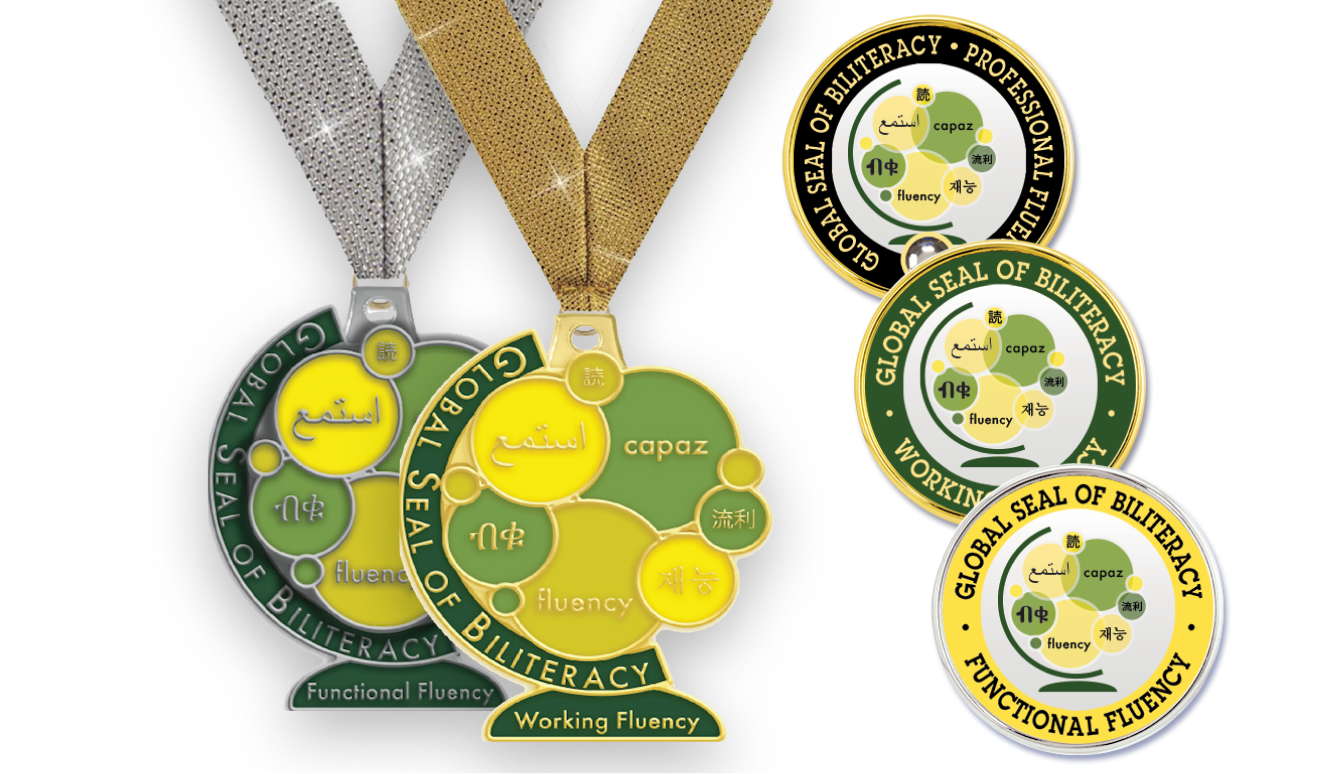
Certification is digital. For graduation and awards ceremonies, your school can order recognition items including printed certificates, medals or pins, and honor cords.

Certifying bilingual school staff
Your multilingual staff are an asset. The Global Seal lets you assess and recognize the language skills of current employees and job candidates.
Certified bilingual staff can:
Communicate directly with students and families in their home language
Bring cultural understanding to classrooms and school offices
Support language learners across subjects, not only in language classes
Widen the perspective your students are exposed to
Strengthen your connection to the communities you serve
Pathway to Language Proficiency
Certification is the goal, but progress deserves recognition along the way.
Our Pathway Awards give you classroom tools to track and celebrate proficiency at earlier levels. Students see how far they have come, and how close they are to the next step.
Level up. Ribbons mark each stage of progress.
Leverage. Benchmark testing shows growth over a year or a course.
Link. Each step connects to the next, ending in Global Seal certification.


Evaluate Your Students Language Level
The Global Seal of Biliteracy has developed free adaptive language proficiency self-assessments based on can-do statements from two major proficiency scales. These can-do statements are reflective of an individual’s language ability based on the Common European Framework of Reference (CEFR) Levels and the ACTFL Levels of Language Proficiency.
Promotional Resources
Once you certify with the Global Seal, we help you tell people about it.
A "We Credential With the Global Seal" badge for your website
Explanatory text for newsletters, handbooks, and program pages
A press release template for your district communications office
Materials to share with students, families, and your board
Frequently Asked Questions
-
Thanks to the generous sponsors and donors, the Global Seal of Biliteracy is a completely free program that certifies an individual’s biliteracy based on language testing. The Global Seal itself does NOT test candidates. All testing is contracted with test companies directly by educational institutions, organizations, businesses or by individuals themselves and testing costs are paid directly to test companies.
-
The Global Seal website describes the processwhich includes:
1. Sign-Up by clicking the Certify tab or button. The Global Seal of Biliteracy is free (cost of testing not included).
2. Submit qualifying scores on an approved test. A referral for testing will be provided upon request. The Global Seal of Biliteracy list of qualifying tests can be found on this website.
3. The Global Seal of Biliteracy award and award certification is issued to qualifying candidates at no charge. Schools and/or recipients may choose to select and pay for optional recognition medals or pins.
-
The Global Seal’s Board of Advisors determine which tests best meet proficiency-based criteria. All tests that qualify for the Global Seal of Biliteracy can be found on our test page and/or can be viewed by language. The Board of Advisors’ work is ongoing, and additional tests, including international tests, may be added. Additionally, deletions and/or modifications may be made to currently qualifying tests as the tests and or testing conditions or criteria may change.
-
The Global Seal currently offers tests in over 125 languages. To find a test in a specific language, please see our Languages page. If you don't see the language that you wish to test in, please contact us at info@theglobalseal.com
-
Many universities have provided college credit, advanced placement and even scholarships to Global Seal of Biliteracy recipients. Additionally, almost 25% of Global Seal certificates are issued by colleges and universities to their own students. To see a list of higher education institutions that have recently issued the Global Seal, click here: https://theglobalseal.com/higher-education.
-
The Global Seal of Biliteracy is universal, it crosses state lines and is issued internationally whereas the individual State Seals of Biliteracy (SSB) are generally available to students graduating from a public school in a state with an individual district or school that has adopted the program (with some exceptions). The Global Seal of Biliteracy certifies all qualifying language learners, regardless of age or grade level, including university students and working adults who would like to certify their language skills for academic or work purposes. The Global Seal is used by programs that may not qualify for a SSB such as private schools, community-based heritage language programs, or language immersion programs. The Global Seal is often used to complement the state Seals to provide earlier benchmark awards, an alternative award to language learners above or below state Seal criteria, or to provide students with more ways to leverage their language skills. For example, a state seal is considered a State Honor on the Common App, whereas the Global Seal is an International Honor. Many schools have adopted both programs to create a pathway of awards and/or to maximize the opportunities their recipients have to highlight and share their language abilities.
For more frequently asked questions please visit our FAQ page.