
Language skills you can verify.
The Global Seal certifies language proficiency with a credential that is verifiable, comparable, and easy to compare across candidates and current employees. Use it to identify the bilingual talent already on your team, screen and hire with confidence for language-critical roles, and expand into new markets where language skills aren't a nice-to-have, they're a must.

Verified language skills across your workforce.
170+
languages we certify
70+
countries where certificates are issued
3
levels of certification, from functional to professional fluency

Verified skills, visible on LinkedIn.
The Global Seal appears directly in a candidate's or employee's LinkedIn "Licenses & Certifications", serial-numbered and verifiable, not self-reported. That gives employers a credential they can trust at a glance, and gives every certified employee a public signal of the language capability your company relies on.

Program Benefits
Verified language skills reduce risk and unlock new markets.
Expanding into new markets, serving multilingual customers, or operating internationally all depend on language ability that actually holds up — not just a resume claim or a self-reported skill. The Global Seal replaces guesswork with a rigorous, four-skill verified credential, so businesses can confidently deploy employees into customer-facing, negotiation, or compliance-sensitive roles where a language mistake carries real cost. For companies pursuing globalization and localization strategies, that's the difference between hoping someone can handle a market and knowing they can.
Find the bilingual talent you already have.
Most companies already have bilingual employees; they just don't know who, or how proficient they really are. The Global Seal gives HR and leadership a simple way to formally identify that talent already on staff, rather than making an expensive external hire when the skill may already exist two desks over. It also creates a defensible basis for language pay differentials.

It's a credential the company can claim, not just the employee.
A workforce of Global Seal–certified employees is a marketable fact: it lets a business point to a verifiable, third-party-issued standard when positioning itself as a multilingual, globally capable company to clients, partners, and investors. In an economy where localization and cross-cultural competence are competitive differentiators, "our team is Global Seal certified" is a concrete, checkable statement. It’s the kind of proof point that carries more weight in an RFP or client pitch than "we have bilingual staff" ever will.
First-mover advantage as the market shifts multilingual
This trend is accelerating, not plateauing. 65% of multinational enterprises are projected to increase investment in multilingual content within the next decade. Companies that build verified multilingual capability now are positioning themselves ahead of competitors who will be forced to catch up later, under more pressure and at higher cost.
Better decision-making and innovation from within
In an Economist survey of 572 international company executives, two-thirds said multicultural teams increase their organization's innovation. Multilingual staff also tend to bring stronger cognitive flexibility. A Penn State University study found bilinguals are better at multitasking and prioritizing, and process information faster while performing better on tasks that require conflict management. This translates into better internal decision-making, as well as improved external communication.
Three Levels of Certification
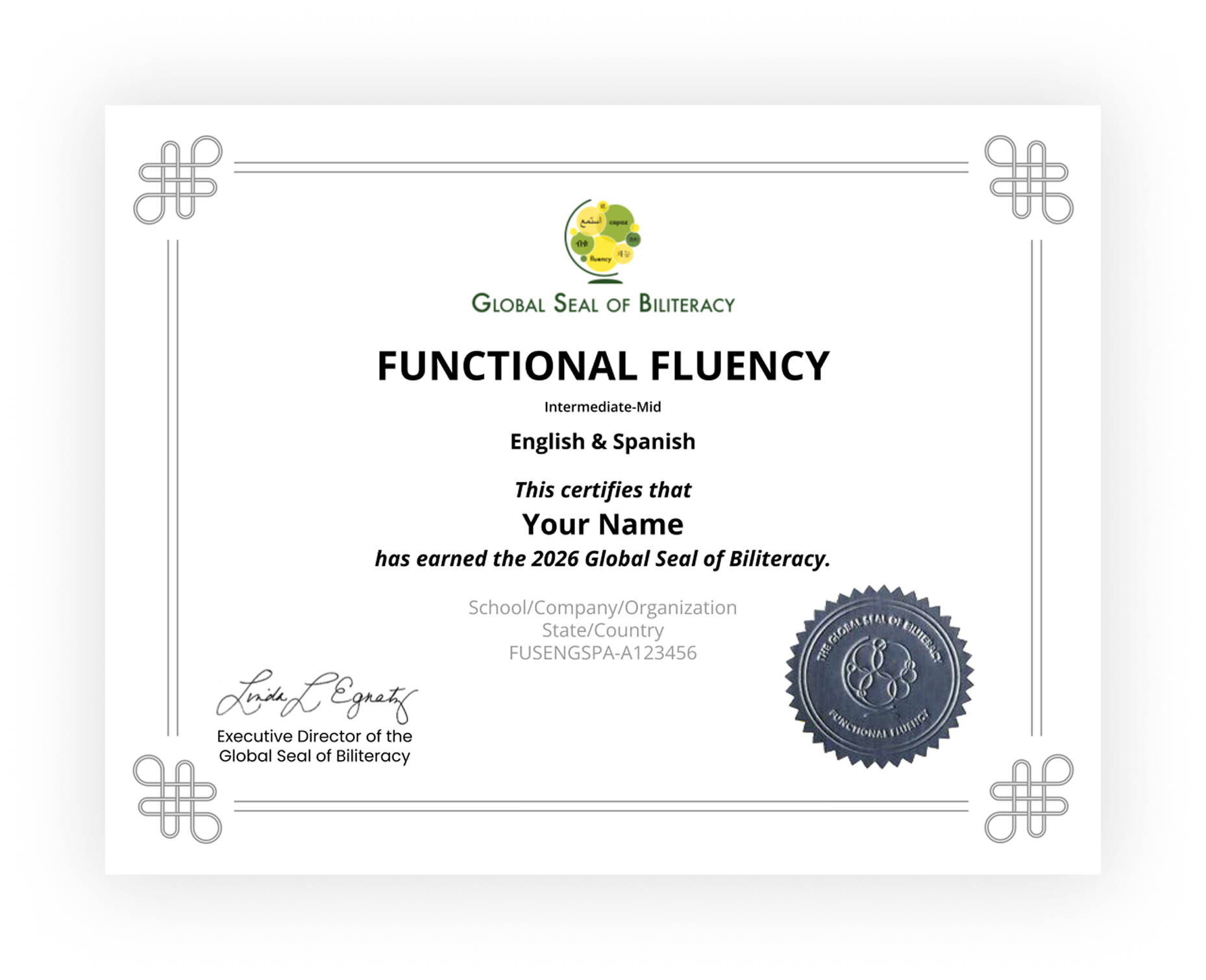
Functional Fluency
This individual can navigate daily routines and predictable situations in their certified languages. They can describe services, follow procedures, and respond to frequently asked questions, though some grammar errors or mispronunciations may occur.
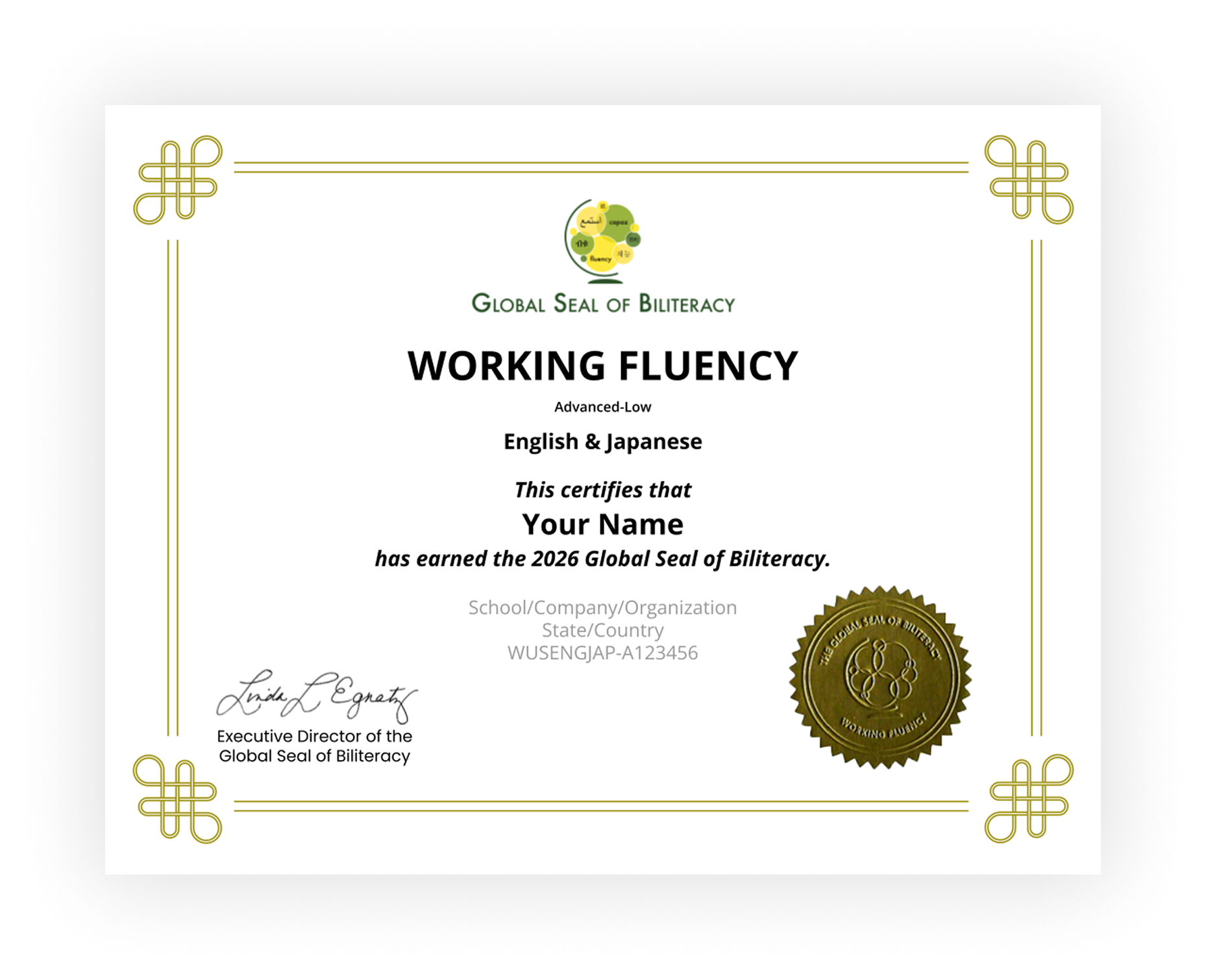
Working Fluency
At this level, the certified individual can handle both routine and unfamiliar situations across formal and informal contexts. They can adjust their language, make recommendations, explain policies in detail, and resolve problems with overall accuracy and understanding.
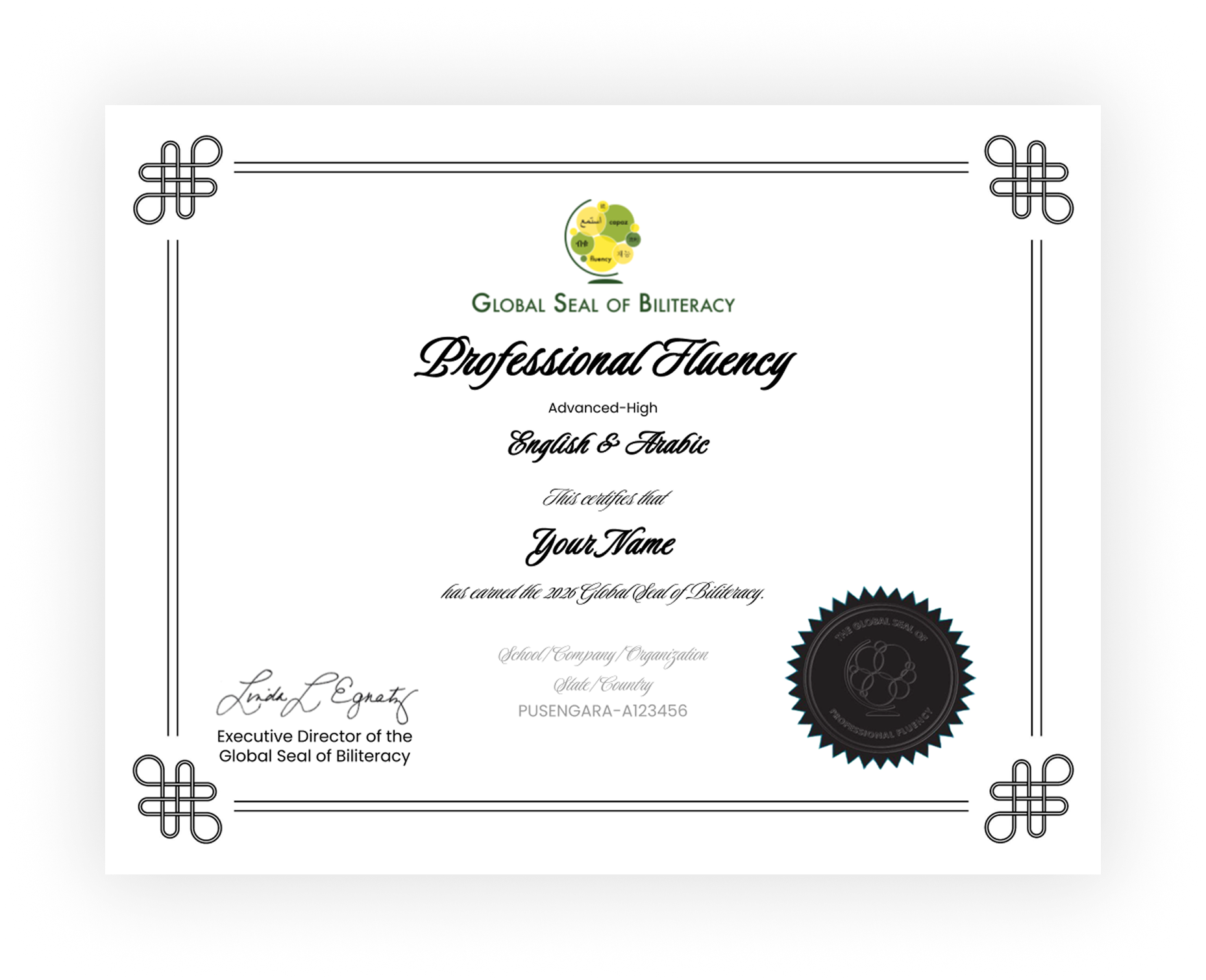
Professional Fluency
The highest certification validates advanced mastery. These individuals interact with precision on a wide range of complex topics. They excel at persuasion, negotiation, delivering presentations, and participating in the linguistic and cultural nuances of professional environments.
How the Global Seal certifies linguistic skills
Verified scores come from you. Your organization facilitates the testing and submits the scores to the Global Seal directly. That direct chain is what makes the credential trustworthy, and it means your employees’ certificates carry your institution's branding, adding value as a recognition tool.
First language of certification. The language the individual knows best across speaking, listening, reading, and writing. It is usually the language of their primary education. Proven with a diploma, a transcript, an official academic record, or a qualifying test score. In the U.S., English must be one of the two certified languages. See accepted documentation
Second language of certification. Proven by testing. Scores must come from an approved test, be less than 12 months old, and be proctored by an impartial person. Many test providers also offer remote proctoring making testing simple.
All four skills. Individuals must qualify at the certificate level in listening, reading, speaking, and writing. Composite scores are not accepted. For less commonly tested languages, a two-skill test of speaking and writing may be used.
Organizations Certifying & Accepting the Global Seal


The Process
A Simple 3-Step Pathway to Certification
Issuing a Global Seal of Biliteracy is straightforward through the program's quick and easy application, and award process. It is completely free of charge (testing costs not included). Providing an international certification to your employees is as simple as sign-up, submit, and receive.
Sign-Up
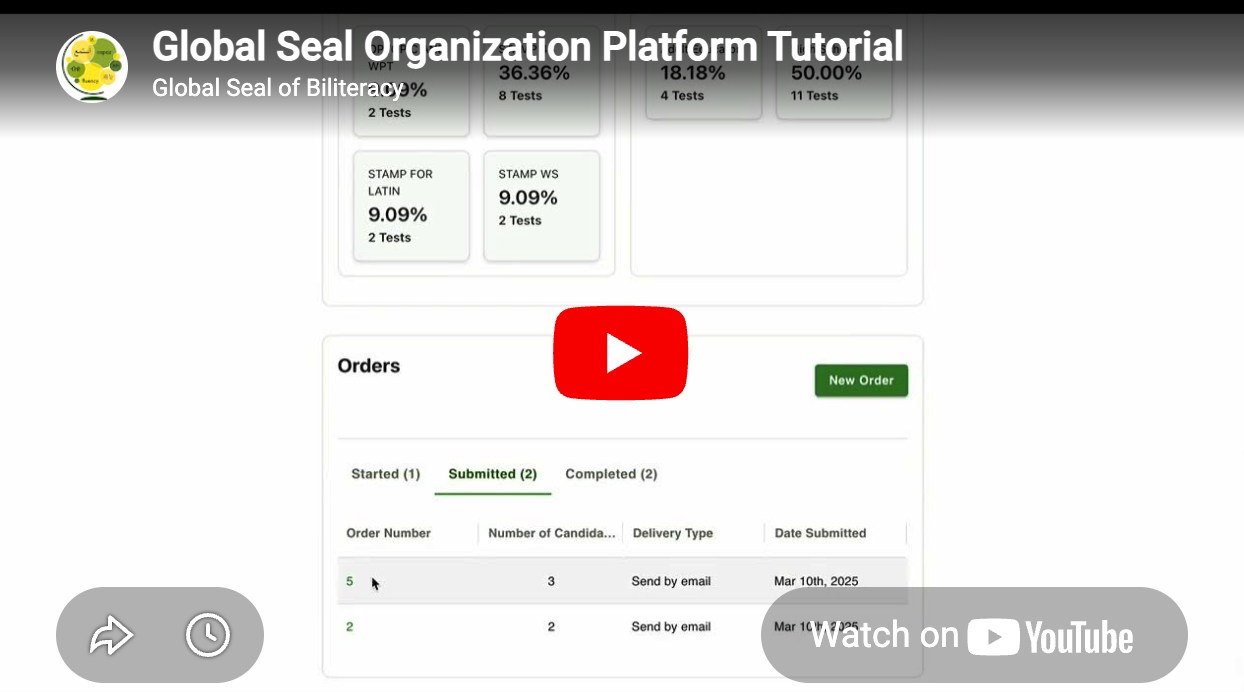
An official representative of the organization signs-up and creates an Organization account on the Global Seal's secure platform. The sign-up process collects contact information and a few details about your program. Once your account is set up, you'll have access to dashboards where you can track certificates issued and measure your program's impact over time.
Submit
To validate proficiency, you'll need to prove skills in two languages for all candidates. This includes uploading test scores from one of our approved language assessments taken within the last 12 months. All applications for the first certification in the U.S. must include English for either the first or second certification language.
Receive
Once scores are reviewed and approved, each qualifying individual receives an official Global Seal certification. It records their first language, their tested language, and their fluency level.
There is no cost to certification. You pay only for testing, and you pay the testing company directly.
How it Works
Frequently Asked Questions
-
The Global Seal is proud to offer a pathway to certification in over 100 languages through one of our approved tests. Visit our Languages page for a comprehensive list of the languages we cover.
-
The Global Seal of Biliteracy can be integrated into existing HR processes in several ways:
Hiring: Use the Global Seal to screen candidates for potential roles. Hiring managers can also find applicants who have already earned a Global Seal through their school, university, or a previous employer.
Employee Skills Tracking: Add the Global Seal to employees' personal files or HR platform management systems to easily track and find needed language skills when required.
Professional Development: The Global Seal's three-tiered stackable certifications motivate employees to continue leveling up their language skills, becoming greater assets to their employers.
-
The Global Seal is an excellent way to recognize employees' language skills in the workplace by providing a meaningful certification they can carry to their next role or employment opportunity. The three levels of certification encourage employees to continue improving their language proficiency, benefiting both the individual and the organization.
-
There is no cost for organizations or individuals to use the Global Seal. However, the cost of testing is not included. Testing must be arranged directly with one of our approved testing companies, and all testing and proctoring-related fees must be paid to them.
-
Yes, we encourage employees to continue testing as they improve their language skills. Our three-tiered stackable certifications are designed to motivate employees to work on and enhance their language abilities continuously.
-
The Global Seal does not directly facilitate testing. All testing is conducted through our approved language test providers, many of which offer remotely proctored solutions. To ensure the validity of test results, all Global Seal qualifying test scores must be obtained through the proctoring (in person or remotely) of an impartial human.
For more frequently asked questions please visit our FAQ page.